Sébastien Migné Leaves Scots Talking After Claiming Scotland Had a “12th Player” During Narrow 1-0 Victory Over Haiti

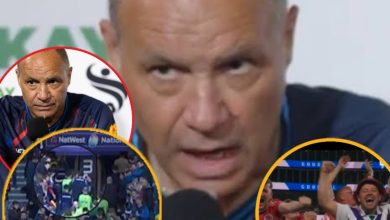
The fallout from Scotland’s tense 1-0 victory over Haiti at the FIFA World Cup continues to dominate football discussions, with Haiti head coach Sébastien Migné delivering a fiery post-match assessment that has left Scottish supporters and football fans around the world talking.
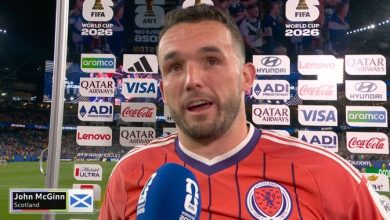
Scotland secured all three points thanks to a well-taken strike from John McGinn in the 29th minute, but while Steve Clarke’s men celebrated a crucial victory in their first World Cup appearance in over two decades, the result was overshadowed by a series of controversial incidents that left Haiti feeling aggrieved.
The match itself was a fiercely contested encounter from start to finish. Haiti entered the game as underdogs but refused to be intimidated by their more experienced opponents. Migné’s side displayed remarkable determination, pressing Scotland aggressively and creating several dangerous opportunities throughout the contest.
However, despite their spirited display, Haiti ultimately left the field empty-handed, and their manager was not shy about expressing his frustration after the final whistle.
Speaking to reporters in a passionate post-match interview, Migné first praised his players for their courage and commitment before turning his attention to what he described as questionable officiating.
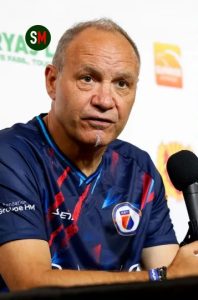
“I am very proud of my players,” Migné said.
“They fought for every ball, they showed courage, they showed character, and they represented Haiti with pride. Against Scotland, we knew it would be difficult. But today it felt like we were playing against more than eleven men.”
The French coach then delivered the comment that immediately began making headlines across the football world.
“To be honest, Scotland had a 12th player out there.”
The remark instantly sparked debate among supporters, journalists, and former players, many of whom had already been discussing several controversial moments from the match.
Migné specifically referenced a first-half penalty appeal that Haiti players passionately protested after Scotland defender Grant Hanley, wearing jersey number five, appeared to handle the ball inside the penalty area.
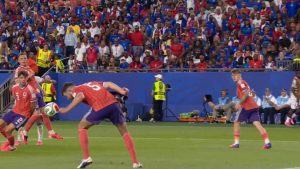
The incident occurred during a dangerous Haitian attack, with several players immediately surrounding the referee demanding a spot kick.
Yet despite the protests, play continued.
More surprisingly for Haiti, there was no intervention from the Video Assistant Referee.
Migné could barely hide his disbelief when discussing the moment.
“Everyone saw it,” he said.
“My players saw it. The supporters saw it. The television cameras saw it. It was a handball inside the box. If that is not a penalty, then what is?”
The Haiti boss went on to question why VAR remained silent despite the apparent nature of the incident.
“We are told VAR exists to correct clear and obvious mistakes. This was clear. It was obvious. Yet nobody said anything. Nobody asked the referee to look at the monitor. Nobody reviewed it properly.”
“It is difficult to accept because these are moments that can completely change a football match.”
The frustration did not end there.
Migné also pointed to a late challenge involving Scotland midfielder Kenny McLean, who was wearing jersey number 23 after coming on as a substitute.
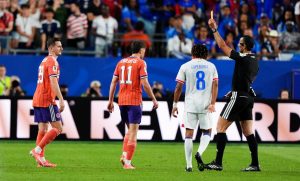
As Haiti pushed desperately for an equaliser during the closing stages, McLean launched into a heavy tackle on a Haitian player that immediately sparked angry reactions from the Caribbean side’s bench.
The referee produced a yellow card, but many Haiti players believed a red card should have followed.
According to Migné, the decision represented another example of inconsistency.
“That tackle was extremely dangerous,” he argued.
“It came at a critical moment of the match. My player could have been seriously injured. For me, it was a red card.”
“Again, the referee chose another way. Again, there was no stronger punishment.”
The Haiti coach stopped short of directly accusing officials of bias but suggested that the major decisions consistently appeared to benefit Scotland.
“I don’t like speaking about referees,” he said.
“I prefer speaking about football. But when important decisions continue to go in one direction, people start asking questions.”
“This is not good for football. We want the game to be decided by the players, not by controversial decisions.”
While Migné’s comments generated widespread attention, Scotland’s camp focused on the positive outcome.
John McGinn’s first-half goal proved enough to separate the two teams after the midfielder expertly finished following a flowing Scottish move in the 29th minute.

From that moment onwards, Scotland demonstrated resilience, defending their lead under increasing pressure from a determined Haitian side that refused to give up.
Several Scottish players admitted afterward that Haiti had made life extremely difficult for them, while Steve Clarke praised his team’s defensive discipline and ability to grind out a result under pressure.
For Haiti, however, the overwhelming feeling was one of frustration rather than defeat.
Their performance earned praise from neutral observers, many of whom felt the underdogs had matched Scotland for long periods and were unfortunate not to leave with at least a point.
As discussions continue over the controversial incidents, Migné remains convinced his players deserved more from the contest.
“I cannot ask for anything more from my team,” he concluded.
“They gave everything. They stood firm. They fought until the last second.”
“Whether people agree with me or not, I believe they were playing against twelve men tonight. But if we show this same spirit in our next matches, Haiti can still make this tournament proud.”
With Scotland celebrating a crucial victory and Haiti left wondering what might have been, the debate surrounding Migné’s explosive “12th player” accusation shows no signs of disappearing anytime soon.