From Controversy to Masterstroke: Daniel Levy’s Unyielding Vision May Finally Pay Off for Spurs

Yet, despite his ambitions, Levy has often found himself in the crosshairs of frustrated fans. Supporters have frequently accused the club’s leadership of lacking true sporting ambition, citing an unwillingness to invest heavily in marquee players or back managers when it mattered most. This perceived frugality, combined with underwhelming results on the field, has fueled repeated protests calling for ENIC to sell the club. From chants in the stands to coordinated online campaigns, the message from some sections of the fanbase has been clear: it’s time for new ownership and a new direction.
The discontent reached new heights earlier this summer, when Tottenham controversially parted ways with Ange Postecoglou. The Australian manager had earned the affection of fans after ending a 17-year trophy drought with a dramatic UEFA Europa League triumph in May. His abrupt departure—reportedly due to behind-the-scenes disagreements with the board—only deepened the rift between the club’s leadership and its supporters.
But for all the criticism leveled at Levy, his long-term commercial strategy has never wavered. Central to that vision was the decision to move on from White Hart Lane—Tottenham’s spiritual home for 118 years—and usher in a new era with a state-of-the-art stadium that would rival the best in the world.

When the Tottenham Hotspur Stadium opened its doors in 2019, it was hailed as a marvel of modern architecture and functionality. With a capacity nearing 63,000, it stands as the largest football stadium in London and the third-largest in England. Beyond its size, the venue was purposefully designed to host everything from NFL games to concerts, making it a centerpiece of Levy’s strategy to turn Spurs into a global commercial powerhouse.
Despite the fanfare, one glaring gap remained: a naming rights deal. The stadium’s generic title was always intended to be temporary, with Levy targeting a blockbuster agreement that would help the club recoup construction costs and boost its revenue streams. Over five years passed, however, with no deal in sight—prompting skepticism over whether Levy’s lofty ambitions had hit a financial ceiling.
Now, that narrative may be on the verge of a dramatic shift.
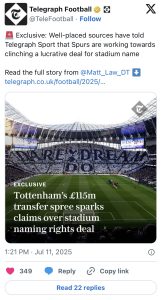
According to Telegraph Sport (July 11), Tottenham are currently in advanced talks to secure a landmark naming rights agreement, with fresh momentum suggesting a deal is closer than ever. While previous reports indicated Levy had been aiming for a world-record package—rumored to be as high as £375 million—sources remain unclear on whether a buyer has finally met his valuation, or if he has chosen to recalibrate his expectations to get a deal over the line.
Regardless of the final figure, any significant naming rights deal would mark a pivotal moment for the club. It would inject substantial revenue into Tottenham’s coffers, potentially enabling greater flexibility in the transfer market and bolstering long-term financial stability—two areas where Levy has often been accused of falling short.
And so, the narrative around Daniel Levy may slowly begin to evolve.
To many Spurs fans, Levy has long been seen as a stubborn operator—unshakable in his belief that commercial growth is the key to sustained success. Critics argue that this focus on branding and balance sheets has often come at the expense of the football itself. Yet, should this naming rights deal materialize as hoped, it could serve as vindication for Levy’s patience, resilience, and unwavering commitment to his vision.
At 63, the seasoned chairman may not win over every critic, but he could earn something far more enduring: the grudging respect of a fanbase that has spent years questioning his methods, but may soon begin to reap the rewards of his persistence.
In football, success is often judged in trophies. But in the world of modern club ownership, building a self-sustaining empire is just as crucial—and Daniel Levy, for all his missteps and controversies, may be closer than ever to proving his masterplan was never about short-term glory, but long-term legacy.