Premier League has released an official statement regarding referee Chris Kavanagh’s on over extra time during the Everton-Liverpool match.
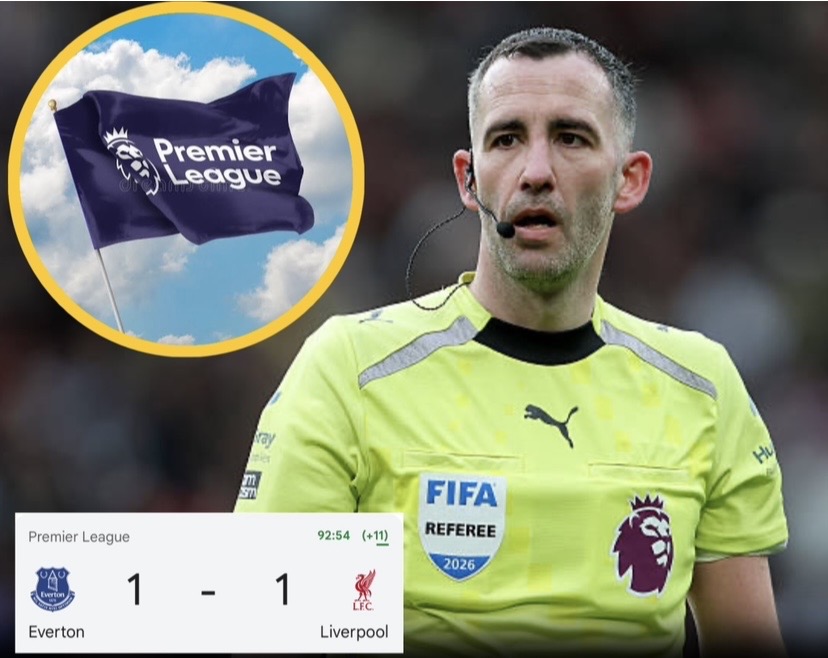
The Premier League has released an official statement addressing the controversy surrounding referee Chris Kavanagh and the handling of added time during the recent Merseyside derby between Everton and Liverpool. The match, already one of the most fiercely contested fixtures in English football, has drawn additional scrutiny due to decisions made in stoppage time that have sparked debate among fans, pundits, and former officials.
In its statement, the Premier League acknowledged the concerns raised following the match, particularly regarding the calculation and communication of added time at the end of the game. According to the league, the fourth official initially indicated a minimum of five minutes of stoppage time. However, the match extended beyond that period, leading to confusion and frustration, especially among Everton supporters who felt the game continued longer than expected.
The league clarified that added time is always a minimum and can be extended at the referee’s discretion to account for further stoppages that occur during that period. These can include injuries, substitutions, time-wasting, disciplinary actions, or goal celebrations. In the case of the Everton vs Liverpool clash, officials noted that additional interruptions during stoppage time justified extending the match beyond the originally indicated five minutes.
Referee Chris Kavanagh, who was at the center of the controversy, followed standard protocol in allowing play to continue until he deemed that all lost time had been sufficiently compensated.
The Premier League emphasized that referees are trained to manage time dynamically rather than adhere strictly to the number displayed on the board. This explanation, while technically accurate, has not entirely satisfied critics who argue that clearer communication is needed to avoid misunderstandings in high-stakes matches.

The statement also highlighted the league’s ongoing commitment to transparency and accountability. It referenced the role of the Professional Game Match Officials Limited (PGMOL), the body responsible for refereeing standards in English football, in reviewing match incidents. The Premier League confirmed that the situation involving Kavanagh would be assessed internally, as is standard practice after every fixture.
Despite the explanation, the incident has reignited broader discussions about officiating consistency in the Premier League. Former players and analysts have pointed out that discrepancies in added time decisions can influence match outcomes, particularly in tightly contested games. In derby matches like Everton vs Liverpool, where emotions run high and margins are slim, such decisions are often magnified.
Everton’s camp reportedly expressed dissatisfaction with how the closing stages were managed, suggesting that the extended stoppage time altered the rhythm and outcome of the match.
Liverpool, on the other hand, maintained that the referee acted within the rules and that added time is inherently flexible. This divergence in perspectives underscores the challenge referees face in balancing fairness with the fluid nature of the game.
The Premier League’s response also touched on the use of technology, including the Video Assistant Referee (VAR), although VAR itself was not directly responsible for the time extension. However, the league acknowledged that VAR checks can contribute to delays and are one of several factors referees must consider when calculating added time.
Looking ahead, the league indicated that it is exploring ways to improve clarity for fans and teams regarding timekeeping decisions. This could include more precise announcements or visual aids to indicate when additional time has been added beyond the initial minimum. Such measures aim to enhance understanding and reduce controversy, particularly in matches with significant implications.
Ultimately, while the Premier League has defended Chris Kavanagh’s handling of stoppage time as being within the قوانین of the game, the incident highlights an ongoing issue in football officiating: the balance between discretion and transparency. As the season progresses, all eyes will remain on how referees manage similar situations and whether further steps are taken to ensure consistency across matches.
For now, the Everton vs Liverpool clash serves as another reminder of how even the smallest decisions can have a major impact in the Premier League, where every second and every call counts.