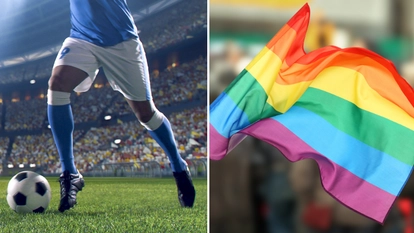
A major development could be approaching in professional football, with a group of players reportedly preparing to make a collective announcement about their sexuality next year in what could become one of the most significant moments in the sport’s modern history.
According to a report in Germany, several professional footballers are considering coming out as gay on the same day, with May 17, 2027, identified as a proposed date for the coordinated announcement.
The reported initiative has already attracted attention across European football, particularly because of the involvement of several established Bundesliga clubs that are financially supporting the project.
While the identities of the players involved have not been publicly disclosed, discussions surrounding the planned announcement are understood to be ongoing, with organisers hoping to create an environment where footballers can speak openly about their sexuality without fearing the consequences for their careers.
The development has also reopened a wider conversation about professional football, with supporters increasingly questioning why male football continues to struggle with openness and acceptance compared with other areas of sport.
CELTIC AND ENGLISH FOOTBALL DRAWN INTO WIDER CONVERSATION

Although Celtic have not been identified as an official financial supporter of the German initiative, the development raises important questions for clubs across British football, including those competing in Scotland and England.
Celtic, one of Scotland’s most recognisable football institutions, operates in a footballing environment where discussions about inclusion, equality and the experiences of players remain important subjects.
The proposed initiative could encourage conversations across the Scottish Premiership, particularly among clubs, supporters and football authorities about how professional players are supported when dealing with personal issues away from the pitch.
English football could also find itself under renewed scrutiny.
The Premier League and English Football League have spent years promoting campaigns against discrimination, while clubs have regularly participated in initiatives designed to make football more welcoming.
However, the possibility of several professional players making a coordinated announcement could test how prepared the wider football community is to support individuals who decide to speak publicly about their sexuality.
There is currently no confirmed indication that Celtic or English clubs are participating in the German project.
Nevertheless, the development could become a significant talking point throughout British football if the proposed announcement goes ahead.
Among the clubs identified as financial supporters of the project are Borussia Dortmund, Union Berlin, St. Pauli, Freiburg and Stuttgart.
Their involvement is significant because the initiative is not simply focused on encouraging individual footballers to speak publicly.
Instead, it aims to challenge the culture that has historically made homosexuality a difficult subject to discuss within men’s professional football.
The project was created by Marcus Urban, a former footballer who publicly came out as gay after his playing career.
Urban has since become an important voice in discussions surrounding homosexuality in professional football and has been involved in efforts to encourage greater openness within the sport.
He and his association are reportedly in contact with players who are considering participating in the planned collective announcement.
Speaking about May 17, Urban explained that the date should be viewed as an opportunity rather than an obligation.
“May 17th is an offer,” he said. “A date that you could use as a guide and get together as a group.”
The idea is to provide footballers with an opportunity to make their announcement together rather than having to face the pressure and attention individually.
WHY MAY 17 HAS BECOME IMPORTANT
The proposed date is particularly significant because May 17 is recognised internationally as the International Day Against Homophobia, Biphobia and Transphobia.
Organisers appear to see the occasion as an appropriate opportunity to bring attention to the challenges faced by LGBTQ+ individuals in professional sport.
The initiative, known as ‘Sports Free’, is expected to provide a platform through which players and coaches can reveal their sexuality.
The platform is expected to go online in the coming weeks, although the full details of how the announcements will be coordinated have not been publicly established.
The organisers are hoping that the involvement of multiple footballers could create a different atmosphere from previous individual announcements.
For years, many have argued that professional footballers have been reluctant to speak openly because of concerns about dressing-room relationships, media attention, public reactions and the commercial pressures associated with their careers.
THOMAS HITZLSPERGER’S ANNOUNCEMENT STILL REMAINS SIGNIFICANT
The conversation also brings back memories of Thomas Hitzlsperger, the former Germany international and Aston Villa midfielder who publicly came out as gay in January 2014 after retiring from professional football.
His announcement attracted considerable attention because he was among the highest-profile former players in European football to speak openly about his sexuality.


Many hoped his decision would encourage other players to follow his example.
However, more than a decade later, homosexuality remains an exceptionally sensitive subject in men’s professional football.
The lack of publicly out active male footballers at the highest levels continues to highlight the difficulties surrounding the issue.
The proposed collective announcement could therefore represent a different approach, allowing several individuals to share the experience rather than leaving one footballer to deal with the entire public reaction.
SPORTS PSYCHIATRIST EXPLAINS WHY FOOTBALL STILL HAS A PROBLEM
A sports psychiatrist has also highlighted the culture surrounding professional football as one of the reasons homosexuality remains a significant taboo.
“ Around professional football there is still this habitus that the sport is associated with very masculine characteristics, fight, dominance, strength, aggressiveness,” the psychiatrist explained.
“It is no coincidence that homosexuality is still a huge taboo in male professional football, while it has always been a part of female professional football.”
The comments reflect a wider debate about traditional expectations of masculinity within men’s football and whether those expectations have made it more difficult for some players to express themselves openly.
For clubs across Europe, including those in England and Scotland, the discussion goes beyond footballing ability.
It also concerns the responsibility of employers, managers, teammates and supporters to ensure that players are treated with dignity regardless of their sexuality.
DOCUMENTARY TO FOLLOW PLAYERS’ JOURNEYS
Another major part of the initiative will be a documentary titled ‘Hide and Seek’.
The documentary is expected to follow the individual experiences and decision-making processes of players involved in the project.
It will provide an opportunity to explore the personal challenges associated with coming out in a professional sporting environment.
Urban has indicated that communication surrounding the proposed announcement is already intensive.
“There is controversy there,” he said.
“Do I still want to wait until the world of football becomes the way I want it to be? Why should I wait?”
He also suggested that an interesting dynamic was developing, with more people beginning to question whether continuing to hide their sexuality was the right decision.
For now, the identities of the footballers remain undisclosed, and the proposed announcement has not yet been completed.
However, if the plans materialise on May 17, 2027, the development could become a landmark moment for men’s professional football.
With several Bundesliga clubs already supporting the initiative, attention could soon turn towards the rest of Europe, including England and Scotland, where clubs such as Celtic operate within the same wider footballing conversation.
The biggest question remains whether this initiative will finally encourage a new generation of professional footballers to speak openly without feeling that they have to wait until their playing careers are over.