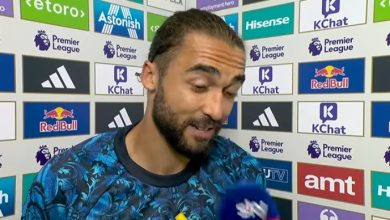
Keith Andrews has praised a Leeds United attacker following his side’s 1–1 draw with Daniel Farke’s team, admitting that the player caused serious problems for Brentford’s defenders throughout the contest.
The Brentford boss revealed that his defensive players became increasingly restless whenever the Leeds attacker received possession, particularly after Brentford took the lead. His pace, direct running and willingness to attack defenders reportedly created a problem Andrews struggled to solve.

What surprised the Brentford manager even more, however, was Farke’s decision to remove the player while Leeds were still chasing the game.
Andrews questioned the tactical reasoning behind the substitution, insisting that the attacker was the one player his defenders were genuinely struggling to contain.
Speaking during his post-match interview, Andrews admitted that the Leeds star man had made his defensive unit uncomfortable and suggested Brentford were relieved to see him leave the pitch.
“He made my defenders restless, especially after we scored. Every time he got the ball, we had to drop deeper because we knew he could run at us, beat a man and create something. He was the one player who kept us guessing, and honestly, I was relieved when I saw him come off,” Andrews said.
The player Andrews was referring to was Daniel James.

James had remained one of Leeds’ most dangerous outlets before being withdrawn in the 68th minute, with Jayden Bogle introduced as his replacement.
The decision immediately became one of the most debated moments of the match.
Leeds had fallen behind and were looking for a way back into the contest, while James remained capable of changing the game with his speed and direct attacking approach.
Farke nevertheless opted to make the change in the 68th minute, bringing Bogle onto the pitch and removing James from the attacking equation.
From Andrews’ perspective, the decision was particularly surprising because Brentford were already struggling to deal with the pressure Leeds were producing.
The Brentford boss suggested that James’ presence had forced his defenders to remain cautious, constantly aware that one mistake could allow the winger to exploit space behind them.
Andrews went further by suggesting that if he had been the person in charge of Leeds, James would have remained on the pitch until the final seconds.
“If I was coaching Leeds, I would have allowed him to play until the last seconds. At that point, I was genuinely clueless about how to stop those vicious Leeds attackers, but Daniel James was the one player giving my defenders a constant threat. Taking him off made our job easier,” Andrews said.
Leeds did eventually find their equaliser only a few minutes after James’ departure, meaning Farke’s decision did not ultimately result in defeat.
However, Andrews believes the outcome could have been even better for Leeds had their most dangerous attacking threat remained on the pitch.
The Brentford manager suggested that Leeds had enough momentum to turn the game around, particularly because his defenders were struggling to deal with James’ movement and direct running.

For Brentford, James represented a different kind of problem to the other Leeds attackers. His ability to accelerate into space meant defenders could not afford to push too high, while his willingness to take players on created additional pressure around the penalty area.

That made his substitution even more difficult for Andrews to understand.
The Brentford boss effectively admitted that the moment James left the pitch, one of the biggest threats facing his team had disappeared.
His comments have since sparked debate among Leeds supporters, with several fans questioning Farke’s tactical judgement.
One supporter argued that taking James off was unnecessary because he was “the only player Brentford genuinely feared,” while another suggested that Farke should have recognised the pressure James was putting on the opposition defence.
There were also supporters who defended the manager’s decision, pointing out that Leeds scored the equaliser shortly afterwards and ultimately avoided defeat.
But the argument remains that the match could have developed differently if James had stayed involved.
Andrews’ comments were especially significant because they came from the opposition manager. Rather than simply praising James for his performance, he openly admitted that the Leeds winger was creating problems his defensive unit could not comfortably solve.
The Brentford boss even acknowledged that, at one stage, he was unsure how to stop Leeds’ attacking players.
Yet, in his assessment, James stood above the rest as the most immediate threat.
“I don’t think Leeds realised how much pressure he was putting on us. When he was on the pitch, we had to think differently because he could hurt us in one action. After he went off, we had one less problem to solve,” Andrews said.
The eventual 1–1 scoreline means both teams left with a point, but Andrews’ assessment has ensured that Farke’s 68th-minute substitution will continue to generate discussion.
Leeds rescued the match with an equaliser, but the Brentford boss believes they may have had an opportunity to win the contest if James had remained on the pitch.
For Farke, the decision will ultimately be judged by results.
For Andrews, however, the answer appears straightforward: keep the player Brentford feared most on the pitch.